

The best windproof lighters for hiking are the ones that still light when you are on an exposed ridge with cold hands and a packed bowl. Wind, freezing air and thin mountain atmosphere all work against an open flame, and the gap between a disposable lighter, a refillable butane torch and a flameless electric device only shows itself once you are out there.
This guide compares those categories on what actually decides a session on the trail: ignition reliability in wind, cold-weather and altitude performance, flavor, weight and upkeep, and where a butane-free electric device like Clean Torch fits.
Table of Contents
- What Makes a Lighter Windproof for the Trail?
- Windproof Lighters Compared: Electric Arc vs. Butane Torch
- Why a Butane-Free Electric Lighter Beats Fuel on the Trail
- High Altitude Smoking Accessories: What Actually Works Above 8,000 Feet
- Maintaining Cannabis Flavor on the Trail: No Butane Taste
- Cold Weather Ignition and Battery Life: What to Expect
- How to Choose: Weight, Durability, and Your Pack
- Final Verdict: The Best Windproof Lighter for Your Next Hike
- Frequently Asked Questions
Last Updated: September 9, 2026
What Makes a Lighter Windproof for the Trail?
A windproof lighter for hiking must protect its ignition source from air movement, which is why traditional soft flames fail on an exposed ridge. Disposable butane lighters get blown out instantly, while refillable torch lighters survive moderate gusts but struggle in sustained wind. The real test is ignition reliability: how consistently the device lights on the first attempt when the air is moving.
For cannabis consumers, this matters every time you stop to pack a bowl at a scenic overlook. Nothing kills a hike's momentum like cupping your hands around a flickering flame while your flower sits unlit. A true windproof design eliminates that struggle because it does not rely on combustion at all. Flameless electric options generate heat through a heating element rather than an open flame, so wind physically cannot extinguish the source.
Windproof Lighters Compared: Electric Arc vs. Butane Torch
Butane torch lighters and electric arc lighters both claim windproof status, but they achieve it through different mechanisms. A butane torch forces fuel through a nozzle at high pressure, creating a concentrated blue flame that resists moderate wind. An electric arc lighter generates a plasma arc between two electrodes, producing heat without any flame. Each approach has trade-offs that become obvious at elevation or in cold weather.
| Feature | Butane Torch | Electric Arc | Butane-Free Electric (Clean Torch) |
|---|---|---|---|
| Ignition source | Pressurized gas flame | Plasma arc | Heated element |
| Wind performance | Good in gusts, fails in sustained wind | Excellent, no flame to extinguish | Excellent, no flame to extinguish |
| Fuel dependency | Needs butane refills | Rechargeable battery | Rechargeable battery |
| Flavor impact | Can impart butane taste | Neutral | Neutral, no fuel near the bowl |
| Cold weather | Fuel pressure drops | Battery drain | Battery drain, reliable heat |
The butane torch has a hidden weakness: fuel performance degrades as temperatures drop and altitude rises. Butane's vapor pressure falls in cold air, producing a weak sputter exactly when you need a reliable light. Electric options sidestep this because they store energy in a battery rather than a pressurized canister. For lighting a bowl on a windy summit, the flameless approach wins on consistency alone.

Why a Butane-Free Electric Lighter Beats Fuel on the Trail
A butane-free electric lighter removes the two biggest failure points of fuel-based lighters: running dry and losing pressure. Disposable lighters end up in landfills by the millions, and refillable torch lighters require carrying a butane canister that adds weight and bulk. An electric lighter recharges from a USB source and holds its charge for weeks of casual use.
The practical benefit for cannabis users goes beyond convenience. When you light a bowl with butane, the flame's combustion byproducts mix with the air your flower draws through. Many consumers notice a chemical taste that masks the strain's true profile. A flameless electric lighter heats the material directly without introducing fuel vapors, preserving the natural flavor and terpene expression. This is the reason Clean Torch uses patented butane-free electric technology: no combustion means no fuel taste and no fumes interfering with your session.
High Altitude Smoking Accessories: What Actually Works Above 8,000 Feet
Altitude performance separates reliable smoking accessories from gear that fails when you need it most. Above 8,000 feet, the air is thinner and oxygen levels drop, which directly impacts combustion-based lighters. Butane lighters struggle because lower atmospheric pressure allows the fuel to evaporate faster while reduced oxygen makes the flame weaker and more prone to extinguishing.

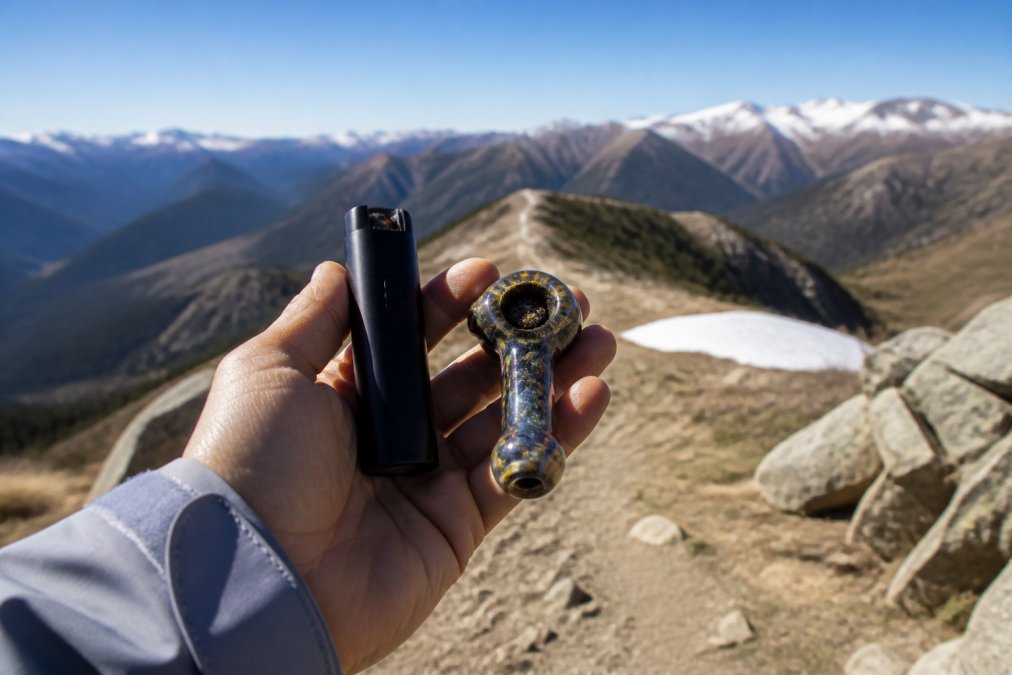
High altitude smoking accessories need to ignore atmospheric conditions entirely, which is why flameless electric heating devices perform so well above treeline. With no flame and no pressurized fuel, the device operates identically at sea level and at 12,000 feet. The heating element reaches the same temperature regardless of air density, making an electric lighter the most dependable high altitude smoking accessory for cannabis consumers who hike, climb, or ski at elevation.
Maintaining Cannabis Flavor on the Trail: No Butane Taste
Flavor preservation is the most overlooked factor when choosing a trail lighter, yet it directly affects how your flower tastes at the summit. Butane combustion introduces byproducts that coat the material and mask the delicate terpenes that define a strain's character. Maintaining cannabis flavor on the trail requires eliminating fuel from the equation entirely.
A butane-free electric lighter heats your bowl through a precision element that reaches the ideal temperature without any chemical intermediaries, resulting in a cleaner, smoother hit that tastes as the grower intended. This is particularly noticeable with aromatic strains where terpene profiles are the entire point.
Cold Weather Ignition and Battery Life: What to Expect
Cold weather is the single greatest enemy of any lighter, and understanding the physics behind the failure modes separates a reliable trail tool from a pocket ornament. This section explains the why and the how of keeping your ignition source functional when temperatures drop below freezing.
The Physics of Fuel Failure in Freezing Temperatures
Butane, the fuel in most disposable and refillable torch lighters, is a hydrocarbon that boils at around 30.2°F (-1°C) (pubchem.ncbi.nlm.nih.gov). Below this temperature, the liquid fuel stops vaporizing efficiently, and the vapor pressure, the force that pushes fuel out of the nozzle, drops exponentially. At 32°F, a standard butane lighter produces a weak, sputtering flame; at 20°F, it often fails to ignite at all.
Refillable torch lighters use a more refined grade of butane, but they are not immune. The industry standard for cold-weather performance is an isobutane blend, often mixed with propane to maintain vapor pressure at lower temperatures. However, most consumer-grade butane canisters sold in the United States are primarily n-butane, which is why they fail in winter. Pre-warming a butane lighter in a gloved fist or against your body can temporarily restore function, but this is a workaround, not a solution.
Battery Chemistry in the Cold: The Real Story
Electric lighters are not immune to cold, but their failure mode is different and more predictable. Lithium-ion batteries operate through electrochemical reactions that slow down as temperatures drop. At 32°F, a battery can lose up to 20% of its effective capacity; at 0°F, that loss can exceed 50% (batteryuniversity.com). This means a fully charged lighter might only deliver half its usual number of heating cycles on a frigid morning.
However, there is a critical distinction: a cold battery does not fail catastrophically. It delivers less total energy, but the energy it does deliver is sufficient to power the heating element to its full temperature. A butane lighter at 20% tank capacity in cold weather produces almost no flame, while an electric lighter at 20% battery charge still delivers a full-power heat cycle. The performance curve is flat until the battery is nearly depleted, whereas butane's performance degrades continuously as temperature drops.
Practical Cold-Weather Management for Your Session
The most effective strategy for managing any lighter in cold weather is thermal management. Your body is a 98.6°F heat source, and an interior pocket is a rudimentary but effective warming drawer. Keep your electric lighter in a chest pocket or an insulated pouch close to your body. This maintains the battery at a temperature where its internal resistance is low, preserving capacity and ensuring the heating element reaches its target temperature on the first trigger pull.
For multi-day trips where overnight temperatures drop below freezing, do not leave your lighter in a tent vestibule or a pack that sits outside. Bring it into your sleeping bag; the waste heat from your body will keep the battery chemistry active. If you are using a butane torch, the same rule applies, but you must also contend with the fuel's vapor pressure, which requires more aggressive warming.
Testing Your Lighter Before You Rely on It
A common pattern among experienced hikers is to test their gear in controlled conditions before a trip. Place your lighter in a sealed container with a thermometer and leave it in a freezer for 30 minutes, then immediately attempt to ignite it. This simple test reveals whether your device can handle the temperatures you expect to encounter, giving you time to adjust your strategy rather than discovering the problem at 9,000 feet on a windy ridge.
The Bottom Line on Cold and Altitude
The interaction between cold and altitude creates a compound problem for fuel-based lighters. At 10,000 feet, atmospheric pressure is roughly 30% lower than at sea level, allowing butane to evaporate more readily while the flame has less oxygen to sustain combustion (noaa.gov). The result is a weak, oxygen-starved flame that is easily extinguished. Electric lighters, which do not rely on atmospheric oxygen, operate identically at sea level and at 14,000 feet. This makes a flameless electric device the only category of lighter that is genuinely elevation-proof, not just windproof.
How to Choose: Weight, Durability, and Your Pack
Selecting the right windproof lighter for hiking is a trade-off exercise. Ultralight backpackers obsess over grams, while weekend warriors prioritize convenience. The key is understanding the full system weight, not just the device itself, but everything you must carry to keep it functional.
The Real Weight of Fuel-Based Systems
A bare disposable butane lighter weighs approximately 0.8 ounces (23 grams), but it is a single-use item with a finite lifespan. For a week-long trip, you might carry two or three, bringing the total to nearly 2.5 ounces. A refillable torch lighter typically weighs between 2 and 4 ounces, and you must also carry a butane canister for refills, a standard 300ml canister weighs about 7.5 ounces when full.
Electric lighters, by contrast, carry their entire energy supply internally. A compact electric lighter with a 3000mAh battery weighs approximately 3 to 4 ounces, with no fuel to carry, no canister to pack, and no consumable to track. For a multi-day trip, an electric system is lighter than a butane torch plus a spare fuel canister, and it eliminates the risk of running dry mid-hike.
Weight-to-Reliability Ratio: A Data-Driven Look
For ultralight hikers, the relevant metric is not raw weight but the weight-to-reliability ratio. A 0.8-ounce disposable lighter that fails in wind, cold, or at altitude has a poor ratio because its reliability is conditional. A 3.5-ounce electric lighter that ignites consistently in a 30 mph gust at 10,000 feet has an excellent ratio because its reliability is unconditional. The more conditions under which a device fails, the more backup devices you must carry, increasing your total pack weight.
Durability: What Actually Survives the Trail
Durability is not just about impact resistance; it is about environmental sealing. Dust and moisture are the two most common killers of lighters on the trail. A device with a secure chamber seal prevents fine trail dust from entering the ignition mechanism and prevents condensation from shorting the electronics. Look for an IP rating or at least a robust gasket around the heating chamber and the charging port.
Long-Term Maintenance: Keeping Your Lighter Functional
Most lighter guides ignore the maintenance that keeps a device functional over years of use. A butane torch requires periodic purging to remove air from the fuel tank, which causes inconsistent flame performance. The nozzle can also clog with impurities in lower-grade butane, requiring careful cleaning with a compressed air duster.
Electric lighters have different maintenance needs. The heating element can accumulate carbon residue from repeated contact with flower, reducing heat transfer efficiency over time. Cleaning is straightforward: use a soft, dry brush or a cotton swab with isopropyl alcohol to gently remove residue from the heating element and the chamber, then allow it to dry completely. Keep the charging port free of lint and moisture, and wipe the device down after each trip.
The Modular Advantage for Cannabis Consumers
For cannabis consumers, the lighter must interface with glassware. A device with a fixed heating head may not seat properly on different bowl sizes, leading to poor heat transfer and inefficient lighting. A modular design with interchangeable heating heads solves this problem. Clean Torch's modular system includes heating heads in 12mm, 14mm, and 18mm sizes, covering the vast majority of standard bowls and bongs, so one device can serve your entire rotation.
Making the Final Call
The decision matrix is clear. If you are a day hiker who stays below treeline in moderate weather, a butane torch may suffice. If you hike at altitude, in cold weather, or in exposed conditions, and you want to preserve the flavor of your flower, an electric, butane-free lighter is the superior choice. The weight penalty is minimal, the reliability is unconditional, and the maintenance is simpler. For the cannabis consumer who treats the summit session as a ritual, the choice is about ensuring the device works every single time without compromising the quality of the experience.
Final Verdict: The Best Windproof Lighter for Your Next Hike
The best windproof lighters for hiking eliminate combustion entirely, because a device with no flame cannot be extinguished by wind. Butane torches offer a partial solution that fails in cold weather and at altitude, while disposable lighters are nearly useless on exposed trails. For cannabis consumers who want consistent ignition and clean flavor, a butane-free electric lighter is the superior choice.
Clean Torch delivers on every criterion that matters for hiking: windproof and flameless operation, rechargeable convenience, and a design that preserves your flower's natural taste. The Starter Kit at $125.00 includes both the 12mm and 14mm heating heads plus the 3000mAh battery, giving you a complete trail-ready setup. For collectors, The Garden Tok Limited Edition Complete Set in Green at $145.00 adds a distinctive look without sacrificing performance. Individual modules start at $35.00, with the battery available separately at $65.00 for those who already own compatible hardware.

Wind, altitude, and cold no longer need to dictate when or where you enjoy your session. Get started with Clean Torch and experience a windproof lighter that works as reliably at 10,000 feet as it does on your back porch.
Frequently Asked Questions
Why do traditional butane lighters fail at high altitude?
Butane lighters rely on gas vaporizing from a liquid state. At altitude, lower air pressure and colder temperatures slow that vaporization, producing a weak, sputtering flame that wind can kill instantly. The ignition mechanism also struggles in thin air. Electric flameless options like Clean Torch use a heating element instead of combustion, so they deliver consistent heat whether you're at sea level or on a 10,000-foot ridge, making them the most reliable windproof lighters for hiking.
Are electric windproof lighters allowed in carry-on luggage?
TSA regulations permit electric lighters, including plasma arc and heated coil designs, in carry-on bags because they do not contain fuel. Traditional butane lighters face restrictions, especially torch-style lighters, which are often prohibited. If you're flying to a trailhead, a rechargeable butane-free electric lighter solves the travel problem entirely. Always check current TSA rules before you pack, and remember to fully charge your device once you land for reliable sessions on the trail.
Will cold temperatures drain my electric lighter's battery faster?
Cold weather does affect lithium-ion battery performance. At freezing temperatures, you may notice reduced output or a shorter charge cycle. Keep your electric lighter in an inside pocket close to your body heat when you're not using it. A rechargeable battery provides dozens of heating cycles per charge, so even with cold-weather drain, you'll have plenty of power for a day hike. Warm the device before use if it's been exposed to extreme cold.
How do I keep my windproof lighter working on a multi-day backpacking trip?
For multi-day trips, charge your electric lighter fully before you leave and pack a portable power bank if you'll be out for an extended period. A rechargeable battery delivers hundreds of ignitions per charge, which covers most hikers for days. Keep the heating element clean by gently brushing off residue after each use. Store the device in a dry pocket, as moisture is the main enemy of electronics. A butane-free electric lighter eliminates the need to pack fuel canisters, saving weight and space.